Thursday, January 20, 2011

Theatrical Releases Of The Week


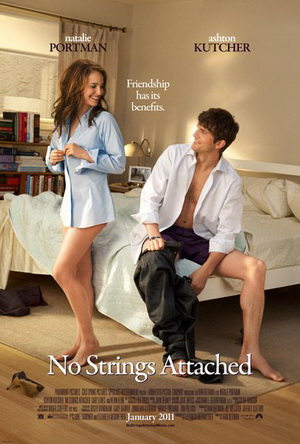
NO STRINGS ATTACHED
Director:  Ivan Reitman
Stars:  Natalie Portman, Ashton Kutcher

WHAT'S IT ABOUT?:  Portman and Kutcher play lifelong friends who, in lieu of relationships, decide to become Fuckbuddies.  Hilarity ensues.  Kevin Kline, Greta Gerwig, and, of course, Ludacris all make appearances.  Director Reitman says ". . .  with this generation in particular, young people find it easier to have a sexual relationship than an emotional one.  That is how the sexes deal with each other today."  I suppose I should expect such open-mindedness from the producer of They Came From Within.

SHOULD I SEE IT?:  I feel as if, at this point in the game, you know which side of the "Do I want to go see the latest Ashton Kutcher movie?" debate you lie on.  If the presence of Portman or Kline pique your interest, let me direct you to a listing of Reitman's shaky post-Ghostbusters resume.  While you're at it, dwell on the possibility of this ass-clown directing Ghostbusters 3 in a year or so (I don't think it'll really happen, but it is a threat).


THE COMPANY MEN
Director:  John Wells
Stars:  Ben Affleck, Tommy Lee Jones, Chris Cooper, Kevin Costner

WHAT'S IT ABOUT?:  Downsizing, and what a varied grouping of white collar workers do when their world comes crashing down around them.

SHOULD I SEE IT?:  The reviews are mainly positive, with longtime TV Jack-Of-All-Trades John Wells making a strong theatrical directing debut.


THE WAY BACK
Director:  Peter Weir
Stars:  Jim Strugess, Colin Farrell, Ed Harris

WHAT'S IT ABOUT?:  A bunch of prisoners escape from a Siberian Gulag during WWII.  Based on an autobiographical book entitled The Long Walk, by Slawomir Rawicz, it's a moving story of courage and determination. . .

SHOULD I SEE IT?:  . . .  a story that, unfortunately, turned out to be complete horseshit.  Yep, this is one of those Oprah-style "Duped by the Fictional Autobiography" type of stories.  Wah wah.   On the flip side of that, and from my perspective;  who cares?  It's still a new film directed by Peter Weir, one of the best directors working, with a terrific cast.  And if you want historical accuracy, read a book (but not The Long Walk)!  Is "My Darling Clementine" an accurate portrayal of the life of Wyatt Earp?  Nope.  Is it a great movie?  Yes, it is.

Critics seem to be generally pleased with this one, although the January release for such a high-profile film is suspect.  Proceed with caution.

Wednesday, January 19, 2011

The Villains In "Dark Knight Rises" Revealed

Christopher Nolan's third, and final, Batman movie has been shrouded in mystery.  We've known for awhile that Tom Hardy had been cast as a villain, but there was no announcement as to which character he would be playing.  Until now.


Bane, sort of an evil version of Doc Savage, with the fashion sense of El Santo, will be played by the Inception veteran.  Given the over-the-top nature of the character, it's likely that his interpretation in Nolan's more "grim 'n' gritty" universe will be barely recognizable.  The villain has previously appeared in the infamous film Batman & Robin, as kind of a near-mindless henchman to Arnold's Mr. Freeze, but the original comic character is a deadly mixture of brawn and brains; in his very first story arc, he figured out Batman's secret identity, temporarily broke his spine (!!!), and single-handedly took over the Gotham underworld.  The source of his incredible physical strength, and his greatest weakness, is the drug known as "Venom", which acts as a sort of Super-Steroid, and is highly addictive.


Secondly, Anne Hathaway will be portraying Selina Kyle, who in the comics is the alter-ego of Catwoman. In the press release today, WB specifically said "Selina", and not "Catwoman", so I'm not exactly sure what to make of that.  Does she become Catwoman towards the end of the film, much like Harvey Dent's turn in The Dark Knight?  Maybe the sometimes villain, sometimes hero takes up Batman's cause when he "retires" (This being Nolan's last Batman, I'm imagining it will have some type of conclusion to his trilogy)?

I'm really pleased with the casting of Hardy as the main villain, and I think that Bane is a potentially great choice.  He's a character who's fairly unknown, and never been done well in movie form, so it'll give Hardy the chance to make the character his own.  He's also a good counterweight to the previous film's heavy, the Joker, since he's a relatively sane villain who's obsessed with power and money;  quite the opposite of the character that Heath Ledger posthumously won an Academy Award for.

But Catwoman?  Michelle Pfeiffer pretty much nailed it in Batman Returns, so Hathaway will have to bring a much different spin to the character.

Exciting stuff.  This one's still a year and a half away, so don't start getting too hyped yet, but Nolan seems to be getting better, and more confident, with each film he makes.  If this turns out even half as good as Inception, I think we're in for one of the best movies of 2012.

"Social Network" Producers Bring Us "Sex on the Moon"

WARNING: THIS PICTURE HAS ABSOLUTELY NOTHING TO DO WITH THE MOVIE

Critics and audiences alike have proclaimed the film The Social Network to be the greatest thing since bread (sliced or otherwise), so while a literal sequel would be implausible, and most likely uninteresting, the movers and shakers who brought it to the screen are teaming up again to bring us another tale of nerdery and lawyers.

"Sex on the Moon: The Amazing Story Behind the Most Audacious Heist in History", a currently conceptual, soon-to-be book by Ben Mezrich (author of "The Accidental Billionaires", from which The Social Network was adapted), has already had it's film rights purchased by Social Network producers Scott Rudin, Michael De Luca, and Dana Brunetti.  It tells the true life story of Thad Roberts, a young NASA employee who stole some moon rocks from Johnson Space Center, with the assistance of his girlfriend, and attempted to sell them on the internet.  For more details, check out this 2004 news article about the heist.  No word on casting or directing choices at this time.

It's a good story, and could be either really funny, dramatic, or both.  This Roberts character sounds like he was a straight-shooter ("with upper-management written all over him"), so it'll be interesting to see how they show his descent into reckless and, frankly, stupid criminal behavior.  Based on the title of the book alone, I'm guessing that they blame the blonde.

While nerdy, Roberts was also an athlete, and prospective astronaut, so that'll extend the casting range beyond your usual "nerd types" like Jesse Eisenberg (Though I'm sure they'd be thrilled to have him back in the fold in some capacity).  Will David Fincher return to direct?  I kind of doubt it.  The dude has a lot on his plate right now.  Current plans involve a new adaptation of 20,000 Leagues Under The Sea, and I could see him using his inevitable Post-Oscar clout (Believe it!) to get his long-in-gestation adaptation of Arthur C. Clarke's "Rendezvous With Rama" off the ground.

Via the LA Times

Tuesday, January 18, 2011

Blunderbuss 2.0 coming soon! (and how you can help)


Alright kids;  I've successfully dipped my toes into the water with this, so it's time to take the next step.  I'm going in up to my knees.

Starting this week, I'm going to attempt to infuse the site with some selected news editorials.  Not every single rumor that's out there;  I don't care who's playing a waiter in a single scene of The Avengers, or when the latest Joan Plowright film is coming out.  My criteria for posting a news story will be, "Is this interesting to me, and do I have anything to say about it?".  It'll be nerd-centric, mostly about movies, and a good conversation piece.

Secondly, I'm going to be doing a weekly preview of new films opening in theaters, and another preview of films being released on video.  It'll keep you guys in the know, so I can help steer you in the direction of good films that got little to no press, or steer you away from what's getting bad "buzz".

Thirdly, I'm going to be doing a bit more of the "Life and other questions" type stuff.  The future wife and I are collaborating on some Dinner And A Movie themed recipes to go with certain films, and we'll both be writing more about novels, comics, video games, and other random topics.

And last;  I'd like your input!  I'm hoping to build this into a "go-to" place, mostly for friends of mine, to get the latest movie news and reviews.  So let me know what's been working for you so far, what else you'd like to see, and what you'd change.

Thanks for reading so far, and I hope to see more of you guys in the future!

Sunday, January 16, 2011

Director Of The Week: Barbara Kopple

BARBARA KOPPLE (July 30, 1946 New York, NY - )

Can a film really change the world?  Barbara Kopple seems to think so.  Since the early seventies, she's been filming the lives of people that you wouldn't see on the nightly news, and showing us a different, more rounded side to every story.

Working with a collective of independent filmmakers in 1971, she helped film the Winter Soldier Investigation; a three day event, sponsored by Vietnam Veterans Against the War (VVAW), that involved recording the testimony of over a hundred veterans, who had either seen war crimes take place, or had committed war crimes themselves.  The footage was collected into the documentary film, Winter Soldier (1972).

Emboldened by this collaborative effort, Kopple struck out on her own to film a strike organized by mine workers in Harlan County, Kentucky, beginning in 1972.  Four years later, her film, titled Harlan County USA, was released to wide acclaim, eventually winning the Oscar for Best Documentary Feature.  The film solidified her style; honest, straight-forward, and without direct commentary.  She lets the "characters" do the talking; and boy, does she ever find some characters!

Over the years, she's directed several other documentary films (Winning the Oscar again in 1991 for American Dream, another strike-centric film), as well as TV episodes for shows such as Homicide, and television commercials.  She's made one critically lambasted fictional feature (a requirement of all great documentarians, it seems), Havoc (2005), which stars Anne Hathaway as a rich white girl who decides to start hanging out with an East LA gang.

Some notable works include:  Friends For Life (1998), a documentary that aired on The Disney Channel, about a  11-year old boy living with HIV;  Shut Up and Sing (2006), a chronicle of the right-wing's assault on The Dixie Chicks, following their "unkind" statements about President George Bush; and Bearing Witness (2005), the story of female reporters who chronicle war from the front line.

Still very active, and one of the most recognized and respected names in the documentary world, she still has many years left to help make a difference.

Saturday, January 15, 2011

Purity Of Form: Finding The Right Medium In Which To Tell Your Story

In the beginning. . .

When an idea for a story was formed, it was then channeled into one single medium:  a book, a movie, or a play, for example.  But today, ideas are often pre-planned as multi-media enterprises right off the bat;  sometimes before they're even fully-formed ideas.  Take the latest Tron film:  It's a movie, sure; but it's also a soundtrack, clothing, video games, books, toys and monorails.  It's a logical enough formula, so I understand why it's so common.  George Lucas has made a pretty penny from his Star Wars movies, but could fund his own country with the money he's made from "ancillary" toy sales.

This "branding" process has lead to the blurring of the lines between different forms of media.  While an interesting idea in theory, in practice it often isn't very successful.  Video Games based on Movies are rushed into production, and terrible.  Likewise, Movies based on Video Games tend to pander too much to their core audience, and aren't willing to adapt to a different storytelling format.  Could a pre-planned, multi-media concept ever truly work?  I think so.  The Wachowski Bros Matrix franchise was not entirely successful, but I admire the effort put into it.  Along with the release of the final two Matrix films, they took a hands on approach to creating video game, anime, and comic book spin-offs.  The level of detail, and appreciation for the respective mediums, that the Bros gave to these spin-offs allowed for some interesting interplay.  The first game, titled Enter The Matrix, followed side characters Ghost and Niobe in their own, partially shot on film, storyline.  It weaved in and out of the narrative of The Matrix Reloaded, to the point that the game become a sort of butt-kicking Rosencrantz And Guildenstern Are Dead.  The anime spin-off, perhaps too cutely titled The Animatrix, fleshing out the backstory of the war with the machines, making it (in my mind) essential viewing for the overall enjoyment of the series.

The Matrix franchise functions so efficiently because the creators recognize the advantages of each individual medium.  Enter The Matrix isn't just an adaptation of one of the films;  it has it's own functioning narrative, and understands that a game needs to be slightly more action than dialogue heavy, and that said action needs to be "taken up a notch".  In fact, a later game, The Matrix: Path Of Neo, ostensibly follows the story of the films, but feels free to make several notable variations.  The Wachowskis appear in the game as 8-bit characters, explaining that the Gnostic Christian, self-sacrificial ending to the movies would be "lame" in a video game, so you end up fighting a gigantic, Constructicon-like version of Agent Smith.

Clearly, knowing the advantages and disadvantages of each medium is key.  With that in mind, let's explore what types of stories are best realized in each format.

BOOKS:


Advantages - The ability to make plain a character's introspection, or to be the voice of an omniscient narrator.  The magic of setting a scene using only paper and ink (or just bytes, perhaps).  Books, having the ability to jump between time periods in a more fluid way than most mediums, can take place over the course of a day as easily as over the course of centuries.  If you really want your audience to feel a deep, personal connection to your characters, it works well when your reader is relying only on descriptors, not pictures;  it allows them the opportunity to fill in the blanks with little pieces of themselves.  To have some small part in the character's creation.  It's most likely the reason why you see people getting so heated over the casting of their favorite characters when novels are adapted into films.

Disadvantages - Anything that one would usually define as "action" takes a big hit.  Seeing someone suddenly get karate chopped in the face has a lot more impact than reading "Woo raised his arm upwards, then brought it down upon Inspector Chan's nose with the full force of his body".  It can also occasionally feel like explaining the world to a blind man.  A reader could be imagining that the main character looks like Tom Cruise, until you casually mention that he has a bulbous nose and a huge scar on his face somewhere around halfway through the book.  Oops.

THEATER:


Advantages - An intimate setting.  The mixture of acting, props, and sets allows for a sort-of "playtime" feel.  The mingling of a tangible reality with the fantasy.

Disadvantages - Due to budgetary and space constraints, you're somewhat limited in scope.  Les Miserables is probably one of the most "epic" stageplays, but even that has a fairly small cast of primary characters.

MUSIC:


Advantages - Whether you're telling a straightforward story from beginning to end, or more obliquely "implying" the story with selected phrases and notes, there a few more effective ways of manipulating an audiences emotions than the proper ordering and pitch of instrumentally formed noises.

Disadvantages - The more details you include, the less of a song it is, and the closer it becomes to poetry.

POETRY:


Advantages - Unless we're talking about a long-form poem, like Beowulf, I would say that brevity is the best advantage here.  Poems are the supermodels of the written word;  stark, sleek, and gorgeous.  All the fat of the narrative has been removed, leaving only the emotions and philosophies.

Disadvantages - The more details you include, the less of a poem it is, and the closer it becomes to a novel.

SPORTS:


Advantages - Sports aren't often considered a storytelling device, but they are a form of entertainment, and come pre-packaged with their own form of enacted drama.  You've got a Protagonist (Your team), an Antagonist (The other team), and a conflict.  There you go;  the very heart of drama.  One doesn't often have a really compelling reason to hate another team, other than to play-act.  You're not demanding vengeance for the Bears murdering your family as a child, or anything like that.

Whether you watch it or play it, sports have an even greater tangibility than theater, and much more unpredictable endings.

Disadvantages - The storylines often devolve practically into Dadaism.  Wolverines are battling Buckeyes?!  Could you image that movie playing at your local cineplex?

PAINTING/ SCULPTURE/ PHOTOGRAPHY/ MISC:


Advantages - Whether we're talking about Andy Warhol or Alfred Gilbert, we're usually talking about a single image representing an entire concept/story.  If you've had one particular image that you REALLY want to share, this would certainly be the way to do it.  It also allows for layering a seemingly simple image with several levels of meaning.

Disadvantages - The "story" behind the piece either has to be known, self-explanatory, extremely well crafted, or unnecessary.

COMIC BOOKS:


Advantages - Time.  Superhero comics are Soap Operas for Nerds; the popular ones are essentially a single storyline, stretched out over decades.  It's an interesting medium, caught somewhere between film and painting:  It has more of a convincing illusion of movement than painting, yet also emphasizes little moments of life in still-frame.

Disadvantages - Sound, outside of speech, has to be either implied, or directly written down, like "THWAM!".

RIDES/ WALK-THROUGH ATTRACTIONS:


Advantages - Complete immersion.  Theme park rides don't always have a "story", but there's always some kind of "theme" to them.  In the case of Haunted Houses, very few books or movies have the same kind of visceral, "fear response" type of effect.

Disadvantages - You'll be thrilled, but not often moved.  Sorry, ET: The Ride!

TABLETOP GAMES:


Advantages - The Board Game element of tabletop gaming lies somewhere between sports and video games in terms of story:  Sometimes there's very little (Hungry Hungry Hippos), and sometimes it can be ridiculously complex (Warhammer).  It gets really interesting once you get to Role-Playing Games.  You could either be the creator of the game, or the creator of the game WITHIN the game.  RPG's, more than any other medium, encourage creativity, so you could end up with a world that's vastly different from the one written down on paper.

Disadvantages - People who mostly play tabletop games are clicky (in their own way), OCD assholes who have no real sex lives to speak of, and love to argue.  Proceed with caution.

VIDEO GAMES:


Advantages - Choose Your Own Adventure on speed.  By allowing to control the thrust of the story, even down to the minutest movements of the character, you have the sensation of being able to do things that no mere mortal has in their power to do (unless you're just playing a Bass Fishing game).  Great for action, horror, and other high-intensity stories, since it's your input that determines whether the character lives or dies.

Disadvantages - Given the current demand for over-the-top action and visual candy, there often isn't much care given to the story.  That has been changing, however, as games have started to become more cinematic.

MOVIES/ TELEVISION:


Advantages - I might take some shit for daring to lump TV and Film together, but really television is just film in serialized form.  Besides; have you seen any of the shows on HBO this last decade?  I would place The Wire and Deadwood above most films that I've seen.

It's a merging of light, sound and framing.  If a Ride moves your body, and a book moves your mind, then a film is working best when it's moving your eyes and ears.  Don't get me wrong;  films can engage your mind, too.  But I think the real art is in a total sensory immersion, where, unlike a video game, you have no choice in where you're headed, and just have to hang on for the trip.

Disadvantages - The unofficial three hour time limit for theatrical films;  that doesn't give you a whole lot of breathing room when it comes to storytelling.  The ridiculous cost of making films means that you see a lot of easy sells (i.e. derivative, uncreative stories).


In the end, it's all about milling your story over, deciding what elements you would prefer to be overt, balancing the plus/minuses of the different mediums, and then catering your story thusly.  Easy peasy.
Thursday, January 13, 2011

I Love You Phillip Morris (Movie Review)

I LOVE YOU PHILLIP MORRIS (2010)
Directors:  Glenn Ficarra and John Requa
Stars:  Jim Carrey, Ewan McGregor

Based on the true story of conman Steven Jay Russell (Carrey), and his love affair with fellow prison inmate Phillip Morris (McGregor).  From the writing team behind Bad Santa, this light-hearted romp premiered at the Sundance Film Festival back in January of 2009, and, other festival appearances aside, has been sitting on the shelf until just last month.

The candy-coated surface of the story are the flim-flams and grifts that Steven perpetrates on his co-workers and wardens, but the chocolate center is the gay love story.  This proves to be the films worst financial handicap, and greatest critical advantage.  Yes, it is a unique twist on your standard, heterosexual version of this type of tale; but is it especially well made?  Nah.  It is, however, quite entertaining.

It does allow one to view the archetypal romantic comedy from a more interesting perspective.  Sure, Phillip Morris is a vacuous character; but is that different from any role that Marilyn Monroe ever played?  They show (well. . .  imply) Ewan McGregor spitting semen into the ocean;  not something that you would ordinarily see in a heterosexual romantic comedy.  Is it the product of two straight writers projecting an overt sexuality onto their gay characters, perhaps simply in an attempt to ruffle feathers?  Is this how most homosexual men would prefer to be portrayed (i.e. This is all of me, take it or leave it)?  Would it be possible to have a completely "innocent" love story between two men, without sex being a central focus?

Sociological philosophy aside, the actors play their parts well, and have great chemistry together.  And the cons, mostly true, are completely outrageous and amazing.  Carrey is perfectly cast in the role, being able to swing ably between "Aw-Shucks" charmer and mischievous swindler.  There aren't any real "show stopper" moments, but there is a steady, reliable sense of wonder and amusement to the proceedings.

I'm looking forward to future collaborations between this writer/director team.  They've got a little tightening to do with their narratives, and perhaps could ease off on the music montages, but their first film out the gate compares fondly with the early work of the Farrelly Bros.

FREDERICK OPINES:  GOOD